 Qidao
Qidao lets users borrow MAI against crypto held in noncustodial vaults
Qidao is the protocol behind MAI, a dollar-targeting stablecoin users borrow against deposited crypto collateral. Its noncustodial vaults keep collateral under user control while enforcing borrowing and liquidation rules. Active MAI vault operations are on Base and Polygon, following the wind-down of legacy deployments. The Mai Finance interface also combines portfolio viewing with routes into lending, perpetuals trading and prediction markets. MAI debt and third-party market positions carry different obligations and risks.
Key takeaway: Borrowing MAI preserves exposure to deposited crypto, while falling collateral value can bring the vault closer to liquidation.
Base, Polygon and Legacy Deployments
Base and Polygon support the active MAI vault offering, while legacy deployments have wound down. An older chain list therefore does not describe the current borrowing footprint. The protocol began with MATIC-backed minting on Polygon in May 2021 and later expanded across multiple networks. That history explains the wider ecosystem references still surrounding the stablecoin, without making every historical deployment available for new borrowing.
Fantom-related token returns remain conditional on resolving a dispute, separate from ongoing vault operations on Base and Polygon.
What Does Borrowing MAI Involve?
Borrowing MAI creates a collateralized debt position, or CDP: deposited crypto secures a loan the borrower owes in MAI. Overcollateralization means the collateral must exceed the debt's assessed value. This lets the owner retain exposure to the deposited asset while accessing stablecoin liquidity. Borrowing can also increase leverage when the proceeds fund additional crypto exposure. The original asset then secures debt while the additional position carries its own market risk. The collateral remains locked within the vault's rules; retaining ownership does not mean the owner can withdraw it freely while debt remains outstanding.
The collateral-to-debt ratio, or CDR, compares collateral value with outstanding debt under the vault's valuation rules. A lower collateral price reduces that ratio even when the MAI principal stays unchanged. Adding collateral or repaying debt increases the ratio, subject to the vault's rules. Borrowing capacity also depends on the collateral type, network and available debt ceiling, not solely on the market value of the deposited tokens.
Liquidation allows another participant to repay debt in exchange for collateral when a vault breaches its liquidation ratio. The applicable threshold belongs to the vault type. Partial liquidation reduces debt and removes some collateral, including the liquidator's compensation. A separate buyRisky mechanism can transfer a severely unhealthy debt position to a liquidator. Partial liquidation therefore does not describe every distressed vault's outcome.
Loan costs follow each vault's configured fee mix. Interest, when charged, accrues in the debt token and increases outstanding debt. A repayment fee applies when debt is repaid and uses collateral tokens; it does not itself accrue through time. Some collateral also incurs a performance fee on earned yield, while an opening fee may apply at minting. A zero-interest loan can still carry repayment or opening fees. The selected vault's terms determine which charges apply and which asset pays them.
Can You View Holdings Without Connecting a Wallet?
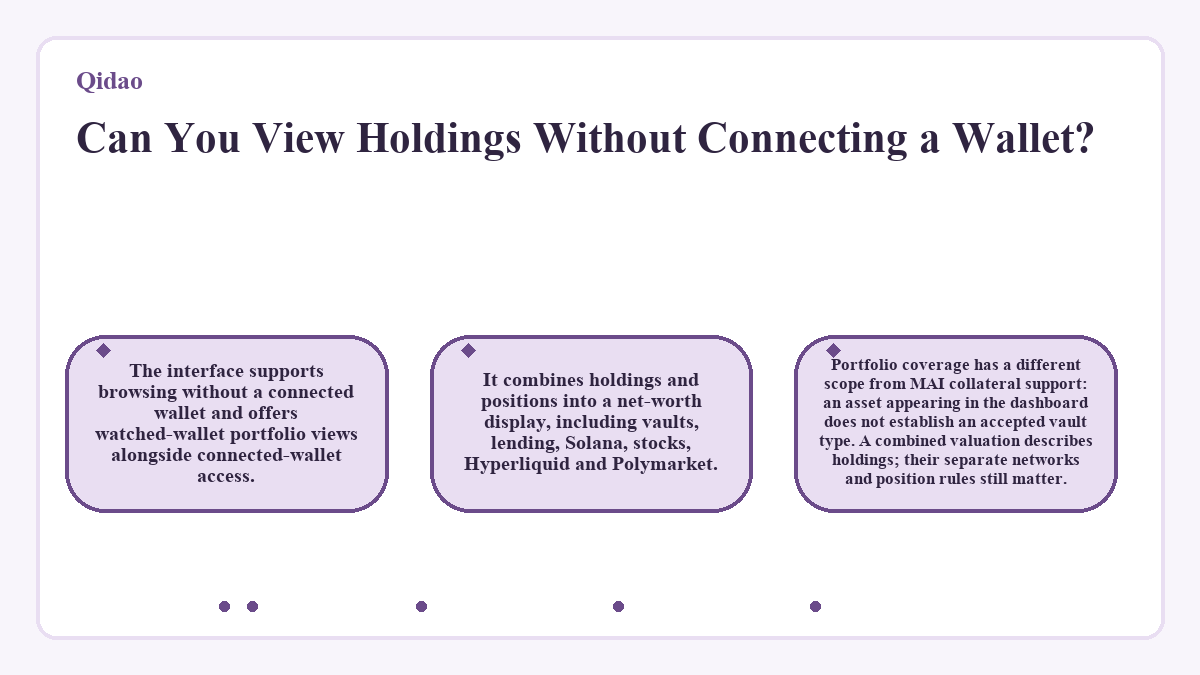
The interface supports browsing without a connected wallet and offers watched-wallet portfolio views alongside connected-wallet access. It combines holdings and positions into a net-worth display, including vaults, lending, Solana, stocks, Hyperliquid and Polymarket. Portfolio coverage has a different scope from MAI collateral support: an asset appearing in the dashboard does not establish an accepted vault type. A combined valuation describes holdings; their separate networks and position rules still matter.
Lending, Perpetuals and Prediction Markets
The interface's lending and trading routes extend beyond collateralized MAI borrowing. Stablecoin lending places idle capital into third-party lending markets and supports automatic compounding at variable rates. Hyperliquid supplies the perpetuals trading venue, while Polymarket supplies prediction markets. A perpetual is a derivative without a fixed expiry; a prediction position reflects a market outcome. These are distinct uses of capital, even when the interface presents funding alongside the same portfolio balance.
| Available Option | Capital Involved | Main Use | Contract Or Market Exposure |
|---|---|---|---|
| MAI vault | Accepted crypto collateral | Borrow MAI while retaining the deposited asset | Vault collateral and liquidation rules |
| Stablecoin lending | Idle stablecoins | Earn automatically compounded, variable lending yield | Third-party lending markets |
| Hyperliquid perpetuals | Trading capital funded from the portfolio balance | Trade perpetual contracts | A separate derivatives position |
| Polymarket predictions | Market capital funded from the portfolio balance | Take prediction-market positions | A separate outcome position |
Routing stablecoins into lending and using interest-bearing collateral inside a MAI vault involve different positions, fee rules and sources of yield.
How Does MAI Aim to Hold Its Dollar Peg?
MAI targets the US dollar through collateral backing and mechanisms which influence supply, demand and redemption incentives. The target does not fix its secondary-market price. Borrowing creates a loan obligation, while repayment helps contract loan-backed supply. Debt ceilings limit the MAI each vault type can issue, and governance can adjust borrowing costs. These mechanisms address different pressures on the peg and operate within the terms of their specific deployments.
The Peg Stability Module (PSM) design sets a 1:1 exchange rate between MAI and approved stablecoins. This provides a separate entry path from a loan against volatile collateral. The module pools deposited assets and routes them into approved yield strategies. Its redemption route includes a public withdrawal queue and a redemption fee, so the fixed exchange rate does not make withdrawal instantaneous or costless. Availability belongs to the deployed module and approved assets, rather than every token shown by the portfolio interface.
MAI obtained through the PSM is fungible with loan-backed MAI, meaning both forms represent the same interchangeable token. The routes use different creation and exit mechanisms. A collateral-backed borrower repays a vault debt; a PSM participant redeems through the module's pooled collateral. Neither the dollar target nor token fungibility gives each holder an unconditional, immediate claim to any underlying vault asset.
Governance and Configurable Loan Terms
The DAO governs through proposals and votes, with aveQI holders voting in the formal process. QI is the governance token; aveQI represents escrow-based voting power. Governance can alter fees, debt limits and collateral settings. These powers concern protocol parameters rather than custody of user deposits. Holding MAI supplies dollar-targeting token exposure, while participating through QI-based governance gives a role in the decisions governing the protocol.
Qidao: frequently asked questions
Can Collateral Keep Earning Yield Inside a Vault?
Accepted interest-bearing collateral can continue earning yield while deposited in a MAI vault. The yield comes from the underlying receipt token or strategy, rather than simply from borrowing MAI. Eligibility depends on the specific collateral and vault type. Where a performance fee applies, its base is the collateral's earned yield, not the entire deposited balance.
Do QI Holders Own Part of the Protocol?
QI is a governance token and does not represent an ownership share in the protocol. The governance process can address revenue distribution, fees, collateral types and other parameters. Holding QI does not by itself guarantee profits, and formal voting uses the protocol's aveQI voting-power system.
Can Additional Collateral Overcome an Exhausted Debt Ceiling?
Additional collateral does not reopen minting capacity when a vault type has exhausted its debt ceiling. The ceiling limits aggregate issuance for that collateral and network, separately from an individual vault's collateral ratio. A healthy position can therefore lack borrowing capacity. Changing the ceiling is distinct from a borrower improving the collateral supporting an existing loan.
How Long Does PSM Redemption Take?
The PSM design specifies a three-day public withdrawal queue for redemption requests. Redemption then requires reaching the front of the queue and paying the applicable redemption fee. Within that module, a user may hold only one pending withdrawal request at a time. These conditions concern PSM redemption, not a guaranteed completion time for every MAI exchange.
Is MAI's Original cross-chain Bridging Architecture Active?
MAI's original cross-chain bridging architecture is paused. Historical descriptions of fungibility across deployments do not establish an available transfer route today. Native minting and bridging serve different functions: native minting uses collateral deposited on the chain issuing MAI, while bridging moves token value between chains. Active vault support on Base and Polygon does not itself confirm a bridge between them.
What Changed With the V2 Design Announced In 2022?
The V2 design, announced on June 28, 2022, introduced a new liquidation engine and additional risk controls. Its design covered vault-level and collateral-and-network borrowing caps, minimum debt settings and tools for retiring collateral types. These were configurable capabilities of the V2 contracts, not fixed values shared by all vaults. The announcement also described separate V1 and V2 contract sets.
Does the Preview APY Apply to an Actual Deposit?
The Mai Finance product preview uses illustrative APY and balance figures. Its displayed APY is not a quoted lending rate for a connected wallet. Stablecoin lending uses variable rates, so its available terms belong to the selected lending market. Watching an address or seeing a net-worth figure does not establish a funded lending position.